Thursday, July 24, 2014
Double Helix: Some Historical Background
This summary is not available. Please
click here to view the post.

Sunday, July 20, 2014
Technology and the Declining Price of Sex
I'm going to talk economics in this post, so be brave.
At the risk of getting myself in trouble, I'm going to declare that sex is an economic good, just as much as chocolate cake is an economic good. We can test this by substituting one word for the other in a paragraph and seeing that, while probably funny, it still makes sense. The fact that there is a whole (generally informal) market to supply this good is further evidence of this notion.
At further risk, I'm going to declare that sex is valued more highly by and sold more cheaply by men than women. This is not a slander against men or women, but rather a simple observation of the costs and risks involved. Women bear the risk of pregnancy, and they have a greater risk of contracting many sexually transmitted infections. Beyond that, there is the social consequences of having sex. For men, they are almost nonexistent, but for women, they can be crushing.
Technology will no doubt put pressure on the market to equalize the demand between men and women in various ways. The process already began with the advent of contraception. That removed one of the major risks of sex. During the 20th century, until HIV appeared on the scene, there wasn't any serious STI that couldn't be cured with antibiotics. Substantial progress has been made on pushing back that particular menace, and a disease that 25 years ago would have been eventually fatal can be held at bay indefinitely. More recently, a true vaccine may finally be in the works, and there is a proposal to use existing antivirals and drugs to stimulate expression of dormant stores of the virus to eliminate them. Potentially, such a treatment could cure someone of HIV.
In my previous post, I made the case that virtual, partnered sex would reduce the risk of having sex. The possibility of anonymity in such a marketplace will remove the social cost for women and the consequent risk. Since risk is one of the factors that increases the price of sex, the price should be driven down and the gap between men and women should partially or totally equalize. What all of this means is that, in the near future of 10-20 years, having a virtual sexual experience that seems just as real as actual sex will be exceedingly inexpensive. Prostitution, if it is to survive, will have to offer an experience that is unique or truly exceptional, and male and female prostitutes should be about equal in number.
The end result of all of this should be an upheaval in the current social order. Slut-shaming should disappear, and men and women will both be able to express themselves sexually without fear of social repercussions. Of course, there are dangers that more than the social order could be upset. What if virtual sex is just as good as real sex, and it is software, rather than a partner, that you interact with? I'll talk about this more in a future post.
At the risk of getting myself in trouble, I'm going to declare that sex is an economic good, just as much as chocolate cake is an economic good. We can test this by substituting one word for the other in a paragraph and seeing that, while probably funny, it still makes sense. The fact that there is a whole (generally informal) market to supply this good is further evidence of this notion.
At further risk, I'm going to declare that sex is valued more highly by and sold more cheaply by men than women. This is not a slander against men or women, but rather a simple observation of the costs and risks involved. Women bear the risk of pregnancy, and they have a greater risk of contracting many sexually transmitted infections. Beyond that, there is the social consequences of having sex. For men, they are almost nonexistent, but for women, they can be crushing.
Technology will no doubt put pressure on the market to equalize the demand between men and women in various ways. The process already began with the advent of contraception. That removed one of the major risks of sex. During the 20th century, until HIV appeared on the scene, there wasn't any serious STI that couldn't be cured with antibiotics. Substantial progress has been made on pushing back that particular menace, and a disease that 25 years ago would have been eventually fatal can be held at bay indefinitely. More recently, a true vaccine may finally be in the works, and there is a proposal to use existing antivirals and drugs to stimulate expression of dormant stores of the virus to eliminate them. Potentially, such a treatment could cure someone of HIV.
In my previous post, I made the case that virtual, partnered sex would reduce the risk of having sex. The possibility of anonymity in such a marketplace will remove the social cost for women and the consequent risk. Since risk is one of the factors that increases the price of sex, the price should be driven down and the gap between men and women should partially or totally equalize. What all of this means is that, in the near future of 10-20 years, having a virtual sexual experience that seems just as real as actual sex will be exceedingly inexpensive. Prostitution, if it is to survive, will have to offer an experience that is unique or truly exceptional, and male and female prostitutes should be about equal in number.
The end result of all of this should be an upheaval in the current social order. Slut-shaming should disappear, and men and women will both be able to express themselves sexually without fear of social repercussions. Of course, there are dangers that more than the social order could be upset. What if virtual sex is just as good as real sex, and it is software, rather than a partner, that you interact with? I'll talk about this more in a future post.
Friday, June 27, 2014
Virtual Partnered Sex: Bringing People Together, Removing Risk
Human beings are weird creatures. It seems like any time there's the potential for a technology that will be transformative and life-enhancing, somebody is going to look at it skeptically, decide that it undermines "what it means to be human", and go on to show through literature, movies, or journalism, that the promises of this great thing are hollow.
Virtual sex is one such technology.You get the typical stereotyping about how lonely nerds are going to be the only people who embrace the technology (probably because they are still virgins who don't know any better). It will destroy intimacy, we are told. Sex and love will cease to be meaningful.
You'll have to pardon me if I think that this is all a bunch of self-important, mystical bullshit, and I'll tell you exactly how this tech is going to change our lives over the next few decades.
The Tech
We already have the groundwork laid for some of this. Real-time motion capture technology like Microsoft's Kinect will probably play a role early, since you'll want to capture every thrust and roll of the hips. More subtle motion, like the use of the tongue and fingers, will be trickier. Probably there would need to be small, disposable sensors used, though I'm prepared to be completely surprised by new tech, as usually happens.
The visual interface is likewise well on its way. We're going to want a full 3-D representation of your partner, which means either stereoscopic video, or more likely a full-body scan and 3-D render. 3-D imagery, after years of skirting the uncanny valley, is just about ready to plunge in and emerge up the other side. Sophisticated scanning models will likely accelerate this process, which itself will be driven by the demand for creating digital actors for movies and television.
We will see two general ways in which the tech can fork. Augmented reality will overlay a digital representation of a person on your field of view of the real world. Virtual reality will create a virtual, shared world, but the essential interactions will be the same. I think that some people will prefer one or the other, but most will indulge in both as the mood suits them.
Haptics brings the possibility of actually feeling another person. As with most things related to the internet, porn will be an early driver of the technology. In fact, there have already been some attempts at pornography that simulates sex through a physical device, but they are predictably flawed and crude. Haptics, which is closely related to robotics, uses mechanical manipulation to simulate touch, pressure, and potentially heat or cold sensations. Virtual sex will, at least initially, require some kind of form-fitting clothing with apparatus for directly stimulating the genitals. Models will continue to be crude in the near future, but as the field of robotics becomes more sophisticated, sexual haptics will begin to rapidly advance.
There would still be limitations, since your body still wouldn't actually take up space in the virtual or augmented world, but I think that people would develop conventions and techniques to best utilize the interface. And, while early systems would no doubt be crude, just as display resolution gets better every year, tactile "resolution" would get better as well.
The ultimate virtual sex experience will arrive when we understand the brain well enough, and have fine enough control, to directly stimulate the nervous system. Eventually, all senses could be stimulated in this manner. While the body is placed in a state of relaxation, the brain would receive the sensory experience of a sexual encounter in a virtual environment.
Distance Won't Matter
Imagine that you just got a new job. You're excited about it, but it will require that you move 2000 miles. Meanwhile, your fiance has two more years of college at a very good school, so it makes no sense for you both to move. You can try to maintain a long-distance relationship, seeing each other every few months, or you can break it off, knowing that the time spent apart will put a serious strain on your relationship, quite likely resulting in a painful break up later on.
That's where virtual sex comes in. We already have virtual sex, limited though it is. It's called "cybersex" and allows couples to perform mutual masturbation over long distances. I've never been very happy with that term. It's a bit like calling a beat up Toyota a shuttlecraft, or a bra an anti-gravity device. It's just way more pretentious and cool-sounding than it actually is. Well, bras are cool, but only for what they contain.
I think the meaning of the word "cybersex" will soon start coming into its own, though. We've gone from chat and instant message, to voice chat, to video chat. The next step will be augmented reality and virtual reality. There are a lot of advantages of these two closely-related concepts over video chatting. To illustrate, I'll describe how you might see it in action.
You and your fiance are 2000 miles apart and you ask to telepresent. He or she accepts and you sit on your sofa and start the session. A camera, possibly multiple cameras, or some other imaging technology, captures each of your images and sends them to each other. Your significant other appears right on the sofa next to you, rendered perfectly into your field of view by your heads-up display. Sound is likewise captured and projected from each environment to the other. There's no sense of touch or smell. The two of you reconnect, talking like you really are in the same room together. One of you suggests sex, and you both undress and tell each other what you want to see the other do.
Safe, Casual Sex
Virtual partnered sex is likely to make casual sex much more common. For one thing, the risk of STDs and pregnancy is gone. The risk of being attacked or stalked will be much lower (though you will still need to be careful how much you reveal about yourself). This is one reason why I think that women, though initially cautious, will jump in as active participants once they realize that there is nothing to lose, but everything to gain.
You could imagine anything from web services which simulate a bar, club, or formal party, where you're expected to be chaste at all times, to MMO-style queues where you're dropped into a room with someone who fits your desired characteristics and you get right to it. I think that there will be a place and a time for both types of interaction, and many others we can only speculate on, such as realistic virtual sex games.
Some might warn that this will destroy marriages, but I am quite confident that the opposite will be true. The ability to have new, fresh sexual experiences will keep the passion alive for many couples that might otherwise burn out. For those that do burn out, sex need not even be a foundational component for marriage. Sharing the duties of children and a household might be enough to hold an otherwise compatible couple together, once the pressure of sex is removed from the picture.
Here's Where it Gets a Little Weird
With the ability to render images so perfectly, there will be the ability to make subtle alterations to conceal your identity from the other person, likely to be common in casual virtual sex. Or, you might fabricate an entirely new persona, even swapping genders by manipulating your voice and scripting in changes to how your avatar moves and feels with a different body. In the beginning, we may see a lot of men having virtual lesbian sex with each other, never realizing that each are lying about their gender. As I said before, women will likely be slower to adopt it, because traditionally they have borne more of the risk, but this will no longer be the case. And, honestly, I think most people will stop caring. If the person you are having sex with looks, sounds, and feels just like a sexy member of whichever gender you are attracted to, and you have no way of finding out otherwise, does it really matter?
Sexual experimentation will be everywhere. People will try things that they were too afraid or embarrassed to in reality. Anyone who watches porn now will likely graduate to virtual porn when it is available. There will be moral questions and legal questions. I think that prostitution will appear immediately, some women transitioning from live sex to virtual sex, others getting into it who would otherwise never take money for sex. I would hope that sensible societies would see the pointlessness and destructiveness of outlawing it. Even the weak arguments the currently keep prostitution illegal would no longer hold, making it entirely a moral religious argument.
The meaning and form of relationships themselves may change. Take my example of a temporary separation and go further. Couples may choose to have long-term, committed relationships, even marry, without ever being in the same physical location. It don't know if it will be common or rare, but I am certain it will happen.
Virtual sex is one such technology.You get the typical stereotyping about how lonely nerds are going to be the only people who embrace the technology (probably because they are still virgins who don't know any better). It will destroy intimacy, we are told. Sex and love will cease to be meaningful.
You'll have to pardon me if I think that this is all a bunch of self-important, mystical bullshit, and I'll tell you exactly how this tech is going to change our lives over the next few decades.
The Tech
We already have the groundwork laid for some of this. Real-time motion capture technology like Microsoft's Kinect will probably play a role early, since you'll want to capture every thrust and roll of the hips. More subtle motion, like the use of the tongue and fingers, will be trickier. Probably there would need to be small, disposable sensors used, though I'm prepared to be completely surprised by new tech, as usually happens.
The visual interface is likewise well on its way. We're going to want a full 3-D representation of your partner, which means either stereoscopic video, or more likely a full-body scan and 3-D render. 3-D imagery, after years of skirting the uncanny valley, is just about ready to plunge in and emerge up the other side. Sophisticated scanning models will likely accelerate this process, which itself will be driven by the demand for creating digital actors for movies and television.
We will see two general ways in which the tech can fork. Augmented reality will overlay a digital representation of a person on your field of view of the real world. Virtual reality will create a virtual, shared world, but the essential interactions will be the same. I think that some people will prefer one or the other, but most will indulge in both as the mood suits them.
Haptics brings the possibility of actually feeling another person. As with most things related to the internet, porn will be an early driver of the technology. In fact, there have already been some attempts at pornography that simulates sex through a physical device, but they are predictably flawed and crude. Haptics, which is closely related to robotics, uses mechanical manipulation to simulate touch, pressure, and potentially heat or cold sensations. Virtual sex will, at least initially, require some kind of form-fitting clothing with apparatus for directly stimulating the genitals. Models will continue to be crude in the near future, but as the field of robotics becomes more sophisticated, sexual haptics will begin to rapidly advance.
There would still be limitations, since your body still wouldn't actually take up space in the virtual or augmented world, but I think that people would develop conventions and techniques to best utilize the interface. And, while early systems would no doubt be crude, just as display resolution gets better every year, tactile "resolution" would get better as well.
The ultimate virtual sex experience will arrive when we understand the brain well enough, and have fine enough control, to directly stimulate the nervous system. Eventually, all senses could be stimulated in this manner. While the body is placed in a state of relaxation, the brain would receive the sensory experience of a sexual encounter in a virtual environment.
Distance Won't Matter
Imagine that you just got a new job. You're excited about it, but it will require that you move 2000 miles. Meanwhile, your fiance has two more years of college at a very good school, so it makes no sense for you both to move. You can try to maintain a long-distance relationship, seeing each other every few months, or you can break it off, knowing that the time spent apart will put a serious strain on your relationship, quite likely resulting in a painful break up later on.
That's where virtual sex comes in. We already have virtual sex, limited though it is. It's called "cybersex" and allows couples to perform mutual masturbation over long distances. I've never been very happy with that term. It's a bit like calling a beat up Toyota a shuttlecraft, or a bra an anti-gravity device. It's just way more pretentious and cool-sounding than it actually is. Well, bras are cool, but only for what they contain.
I think the meaning of the word "cybersex" will soon start coming into its own, though. We've gone from chat and instant message, to voice chat, to video chat. The next step will be augmented reality and virtual reality. There are a lot of advantages of these two closely-related concepts over video chatting. To illustrate, I'll describe how you might see it in action.
You and your fiance are 2000 miles apart and you ask to telepresent. He or she accepts and you sit on your sofa and start the session. A camera, possibly multiple cameras, or some other imaging technology, captures each of your images and sends them to each other. Your significant other appears right on the sofa next to you, rendered perfectly into your field of view by your heads-up display. Sound is likewise captured and projected from each environment to the other. There's no sense of touch or smell. The two of you reconnect, talking like you really are in the same room together. One of you suggests sex, and you both undress and tell each other what you want to see the other do.
Safe, Casual Sex
Virtual partnered sex is likely to make casual sex much more common. For one thing, the risk of STDs and pregnancy is gone. The risk of being attacked or stalked will be much lower (though you will still need to be careful how much you reveal about yourself). This is one reason why I think that women, though initially cautious, will jump in as active participants once they realize that there is nothing to lose, but everything to gain.
You could imagine anything from web services which simulate a bar, club, or formal party, where you're expected to be chaste at all times, to MMO-style queues where you're dropped into a room with someone who fits your desired characteristics and you get right to it. I think that there will be a place and a time for both types of interaction, and many others we can only speculate on, such as realistic virtual sex games.
Some might warn that this will destroy marriages, but I am quite confident that the opposite will be true. The ability to have new, fresh sexual experiences will keep the passion alive for many couples that might otherwise burn out. For those that do burn out, sex need not even be a foundational component for marriage. Sharing the duties of children and a household might be enough to hold an otherwise compatible couple together, once the pressure of sex is removed from the picture.
Here's Where it Gets a Little Weird
With the ability to render images so perfectly, there will be the ability to make subtle alterations to conceal your identity from the other person, likely to be common in casual virtual sex. Or, you might fabricate an entirely new persona, even swapping genders by manipulating your voice and scripting in changes to how your avatar moves and feels with a different body. In the beginning, we may see a lot of men having virtual lesbian sex with each other, never realizing that each are lying about their gender. As I said before, women will likely be slower to adopt it, because traditionally they have borne more of the risk, but this will no longer be the case. And, honestly, I think most people will stop caring. If the person you are having sex with looks, sounds, and feels just like a sexy member of whichever gender you are attracted to, and you have no way of finding out otherwise, does it really matter?
Sexual experimentation will be everywhere. People will try things that they were too afraid or embarrassed to in reality. Anyone who watches porn now will likely graduate to virtual porn when it is available. There will be moral questions and legal questions. I think that prostitution will appear immediately, some women transitioning from live sex to virtual sex, others getting into it who would otherwise never take money for sex. I would hope that sensible societies would see the pointlessness and destructiveness of outlawing it. Even the weak arguments the currently keep prostitution illegal would no longer hold, making it entirely a moral religious argument.
The meaning and form of relationships themselves may change. Take my example of a temporary separation and go further. Couples may choose to have long-term, committed relationships, even marry, without ever being in the same physical location. It don't know if it will be common or rare, but I am certain it will happen.
Sex and Technology: In the Beginning...
The story of sex and technology, as far as we can tell, starts in the Upper Paleolithic era, something like 30,000 years ago. In addition to cave paintings depicting people actually using these things on each other in the stone-age equivalent of internet porn, we have some surviving examples of the actual dildos that were supposedly used, much to her surprise and delight. These devices were made of stone, bone, wood, or tar, basically the closest that our ice-age ancestors could get to high-grade silicone without first inventing modern industry.

Archeologists, upon making this discovery, were understandably embarrassed and scandalized at realizing that their great-great-great. . . great grandparents were not only having sex, but seemed like they were actually kind of kinky. I mean, a dildo chipped out of stone? That's heavy duty. Apparently it was multifunctional too. The item pictured above had a second purpose, being used along with a flint for starting fires. That's two ways to keep her warm.
So, back to the archeologists. In a bid to reclaim their lost innocence after learning things they didn't want to know, they invented an alternate explanation for the purpose for devices of this type. No, these obviously penis-looking things aren't actually dildos. They were weapons, batons to be exact. This explanation has the added benefit of ensuring that History retained its PG rating (for violent content and occasional strong language), otherwise we would no longer be able to teach it in schools. And so, for a time, the status quo was preserved.
Then one archeologist, a very stern-looking gentleman named Dr. Albert Something-or-other, Ph.D. picked up the implement of war and held it threateningly aloft, testing its heft and balance. The other archeologists, bless them, they tried. They really tried to hold in the sniggers, but it was just too much. One of the women couldn't take it anymore and giggled out loud. "I'm sorry, Bert," she said, "but is that a baton in your hand, or are you just happy to see me?" And so, the illusion that your parents, grandparents, and so on never had sex was shattered and the room burst into laughter as Bert sighed and put down the sex toy.
And so that is how we came to recognize that technology has been a partner to sex for a very long time. No one is quite sure when condoms first showed up, definitely by the 17th century, but possibly much earlier. Interestingly, civilizations as far back as ancient Egypt may have used insertable devices called pessaries, kind of like a diaphragm, and they might have been effective to some degree. The one in the picture below came in a box of twelve and were usually enjoyed with coffee.

Much to everyone's annoyance, it wasn't until 1734 that someone found the decency to finally invent a vibrator, and even then, the thing was kind of pathetic. The "Tremoussoir" was operated by a clock spring, so you had to wind it up to use it. Crossing sci-fi sub-genres, we went from stonepunk to clockpunk and have finally arrived at steampunk with "The Manipulator", which looks a bit like something that you might use to pull a train, or for deep-frying chicken.

These devices were expensive, so they were mainly reserved for physicians in the treatment of "hysteria", a condition prevalent up into the early 20th century, which traditionally involved bringing a woman to orgasm with your fingers. This device freed up the doctor's hands, which could be put to more useful duties, such as turning up the volume on the football game while he waits for the pretty, young, unmarried lady in his office to experience an earth-shattering climax while under his care.
(Hmm, making a note here: earn medical license and invent time machine.)
We hit the 20th century running, with battery-operated vibrators, pornography, birth control pills, phone sex, and way, way better sex toys all appearing during or right around this hundred year period. In the 21st, things just keep getting better. In subsequent articles, I'll talk about how I anticipate some of the technologies that are emerging right now, or which seem just around the corner, will expand and enrich the possibilities for our sex lives.

Archeologists, upon making this discovery, were understandably embarrassed and scandalized at realizing that their great-great-great. . . great grandparents were not only having sex, but seemed like they were actually kind of kinky. I mean, a dildo chipped out of stone? That's heavy duty. Apparently it was multifunctional too. The item pictured above had a second purpose, being used along with a flint for starting fires. That's two ways to keep her warm.
So, back to the archeologists. In a bid to reclaim their lost innocence after learning things they didn't want to know, they invented an alternate explanation for the purpose for devices of this type. No, these obviously penis-looking things aren't actually dildos. They were weapons, batons to be exact. This explanation has the added benefit of ensuring that History retained its PG rating (for violent content and occasional strong language), otherwise we would no longer be able to teach it in schools. And so, for a time, the status quo was preserved.
Then one archeologist, a very stern-looking gentleman named Dr. Albert Something-or-other, Ph.D. picked up the implement of war and held it threateningly aloft, testing its heft and balance. The other archeologists, bless them, they tried. They really tried to hold in the sniggers, but it was just too much. One of the women couldn't take it anymore and giggled out loud. "I'm sorry, Bert," she said, "but is that a baton in your hand, or are you just happy to see me?" And so, the illusion that your parents, grandparents, and so on never had sex was shattered and the room burst into laughter as Bert sighed and put down the sex toy.
And so that is how we came to recognize that technology has been a partner to sex for a very long time. No one is quite sure when condoms first showed up, definitely by the 17th century, but possibly much earlier. Interestingly, civilizations as far back as ancient Egypt may have used insertable devices called pessaries, kind of like a diaphragm, and they might have been effective to some degree. The one in the picture below came in a box of twelve and were usually enjoyed with coffee.

Much to everyone's annoyance, it wasn't until 1734 that someone found the decency to finally invent a vibrator, and even then, the thing was kind of pathetic. The "Tremoussoir" was operated by a clock spring, so you had to wind it up to use it. Crossing sci-fi sub-genres, we went from stonepunk to clockpunk and have finally arrived at steampunk with "The Manipulator", which looks a bit like something that you might use to pull a train, or for deep-frying chicken.
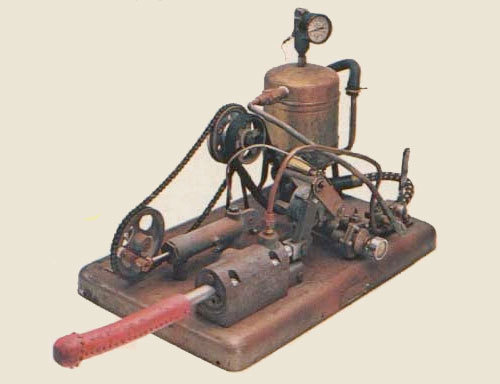
These devices were expensive, so they were mainly reserved for physicians in the treatment of "hysteria", a condition prevalent up into the early 20th century, which traditionally involved bringing a woman to orgasm with your fingers. This device freed up the doctor's hands, which could be put to more useful duties, such as turning up the volume on the football game while he waits for the pretty, young, unmarried lady in his office to experience an earth-shattering climax while under his care.
(Hmm, making a note here: earn medical license and invent time machine.)
We hit the 20th century running, with battery-operated vibrators, pornography, birth control pills, phone sex, and way, way better sex toys all appearing during or right around this hundred year period. In the 21st, things just keep getting better. In subsequent articles, I'll talk about how I anticipate some of the technologies that are emerging right now, or which seem just around the corner, will expand and enrich the possibilities for our sex lives.
Subscribe to:
Posts (Atom)